
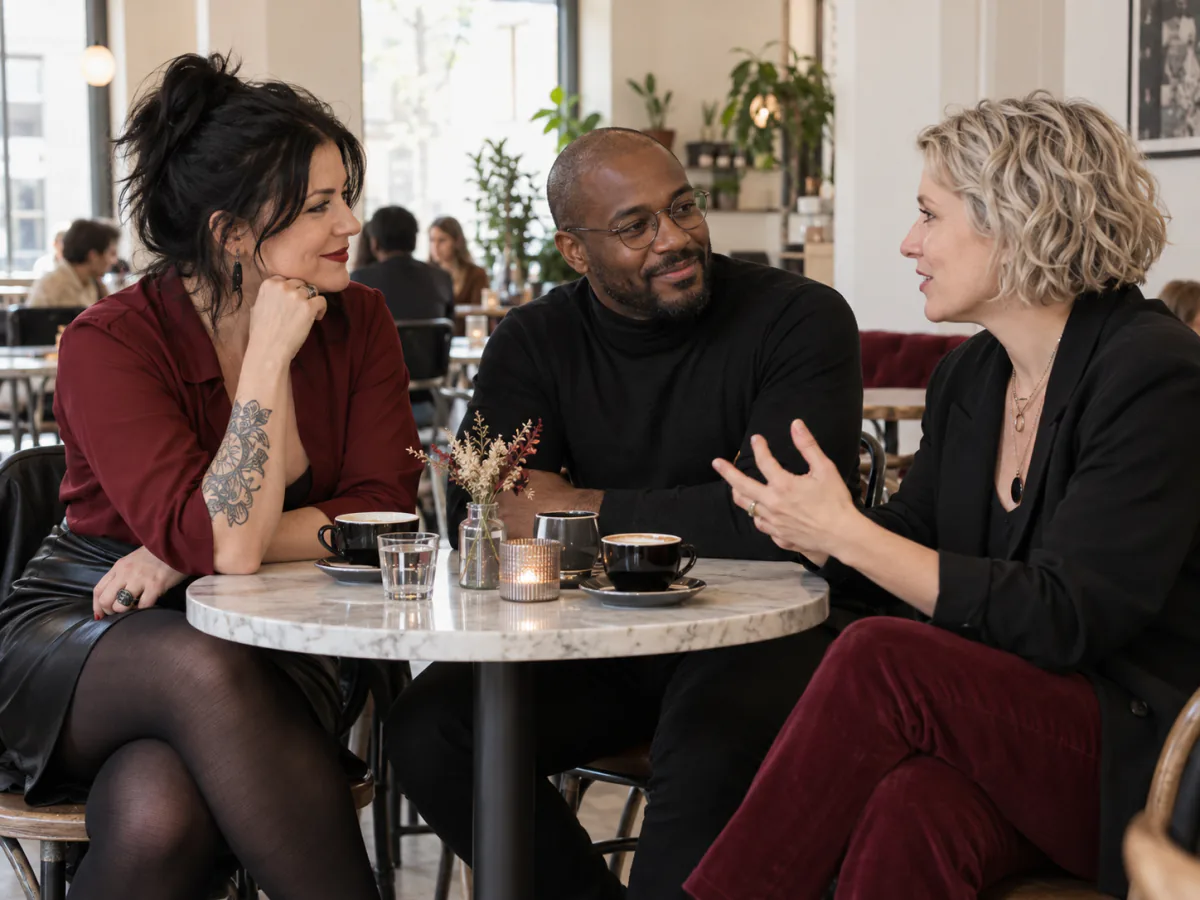
A munch is generally a gathering for conversation, not a night of BDSM activities. Surveys on these gatherings show that people mainly come together to talk, get to know one another, and stay in touch. You can be interested in BDSM and attend a social gathering without engaging in sexual activities.
This aspect is easy to overlook when BDSM is reduced to scenes or props. A study published in 2026 examined the friendships and support that members report finding in their communities. Its findings shed light on what these spaces can offer, without promising the same experience for everyone.
In the 2019 survey, socializing was more important than looking for partners
The term munch refers to an informal gathering of people interested in BDSM, often over a meal or drinks. It’s generally distinct from a play night, although formats can vary. If you’re new to this scene, ask the organizers what’s planned before you go.
In a study published in 2019 in Event Management, Craig Webster and Stanislav Ivanov analyzed two international surveys—one of munch organizers and the other of participants. For the participants surveyed, social motivation stood out more strongly than the search for sexual partners. The two motivations could, however, coexist. The responses do not describe all munches or all people who practice BDSM.
In this survey, therefore, the gathering is not limited to the search for a partner. A group can also serve as a place to reconnect with acquaintances, ask questions, or hear how others articulate their boundaries. The gathering remains a social space; each event sets its own framework, which it’s best to understand before attending.
Connections Are Formed Online and at Gatherings
A 2026 study in The Journal of Sex Research combines surveys of 1,792 people who practice BDSM with interviews of 96 participants. It examines community involvement, connections among members, and the benefits they report gaining from these connections. People who were more involved in a community reported having more extensive BDSM networks and deriving greater benefits from their relationships with other practitioners. These are associations reported by the participants; they are not proof that belonging to a group alone improves a person’s life.
The interviews describe two possible contexts for forming these connections. Online spaces can help people find a group or ask an initial question; in-person gatherings, including munches and certain events, are described as opportunities to build trust. This is not a mandatory path, nor is it the same experience for everyone. Some people are primarily looking for information, while others seek friends or a place to talk about a part of their lives they keep private elsewhere.
The 2019 survey notably recruited participants via FetLife. For the 2026 study, the available abstract does not allow for an assessment of the sample’s representativeness. These studies do not provide figures on the proportion of all people practicing BDSM who find a welcoming community, nor do they establish what would happen without it.
Talking about consent is not enough to prevent abuse
Social interaction can also convey ways of negotiating a practice: asking what is desired, clarifying boundaries, and accepting that a person might change their mind. This does not automatically make a group safe. In a qualitative study published in Sexualities, Alexandra Fanghanel shows that consent plays a central role in the discourse of those interviewed about BDSM, but that violations can still be ignored or dismissed.
A posted rule is no substitute for the actual ability to say no and be heard. A member’s seniority, reputation, or role at an event does not guarantee that they will respect your boundaries. The bonds formed within a group can offer support, but they do not guarantee that a report will be taken seriously. The community is neither a cure nor a guarantee of safety.
Before your first munch, check the setting and keep the option to leave
If you’re considering attending a gathering, start by asking the organizers what’s planned: a casual discussion, a workshop, or a party with sexual activities? Where is it being held, what are the privacy policies, and who should you report inappropriate behavior to? The word “munch” isn’t enough to describe every event. This information will help you decide if this event is right for you.
You don’t have to discuss your sex life, accept physical contact, or continue a conversation that makes you uncomfortable just to be a “true” member of a community. If you’re just coming to chat, you can say so. If the atmosphere or the rules seem unclear to you, you can leave or look for another event.
In a few words
Studies on munches and BDSM communities describe more than just practices: they highlight conversations, friendships, and sometimes support. These studies examine specific experiences without claiming that these spaces are suitable for everyone or that they are free from abuse. If you’re thinking about attending your first munch, it’s best to familiarize yourself with the setting, speak at your own pace, and reserve the right not to return.